Published: 4 June 2026
There are few opportunities more compelling for collectors and historians than the chance to engage directly with the life and work of one of America's most influential founding figures. On 24 June 2026, Sotheby's New York will present the Jay T. Snider Collection of Benjamin Franklin, a landmark sale offering an unparalleled window into the life of the renowned printer, inventor, diplomat, scientist, and statesman.
Carefully assembled over more than 30 years, the collection is widely regarded as the most significant private holding of Franklin material ever to appear at auction. Comprising books, manuscripts, letters, newspapers, almanacks, printed ephemera, and historical artefacts, it chronicles Franklin's remarkable journey from ambitious tradesman to international statesman. Rather than recounting his story through later interpretation, the collection reveals Franklin through the documents he created, owned, annotated, and circulated during his lifetime.
The Collector Behind the Archive
The prized collection belongs to Jay T. Snider, a Miami-based entrepreneur, executive, and philanthropist whose passion for preserving American history has guided decades of collecting. Founder and chairman of UNIT Solutions, a company specialising in non-lethal firearms training systems, Snider has also held prominent leadership roles, including serving as president of the Philadelphia Flyers NHL franchise, and Spectacor.
Over the years, he has developed a reputation for assembling distinguished single-owner collections centred on pivotal moments and figures in American history. The Franklin collection represents the culmination of that pursuit.
Reflecting on the sale, Snider remarked, "I have collected rare Americana for 46 years, and my greatest joy was in studying the most remarkable American, Benjamin Franklin. I am so pleased that it is now in Sotheby's expert hands, where evermore valuable information will be added, for the benefit of the next owners and our understanding of American history."
Highlights From The Sale
1. The founding and funding of the Pennsylvania Hospital
Estimate: $150,000 – 200,000
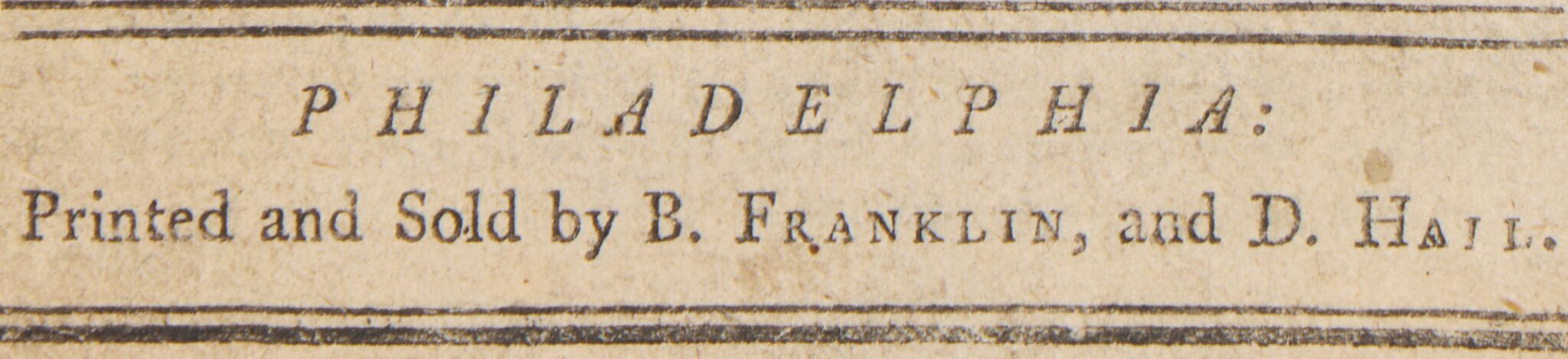
Among the most important lots is an extensive archive connected to the founding of Pennsylvania Hospital, the first chartered hospital in the United States. The group comprises approximately 347 promissory notes printed by Franklin and his business partner David Hall between 1751 and 1754.
The hospital was established through the efforts of Franklin and pioneering physician Thomas Bond to provide medical care for the poor free of charge. To secure public funding, Franklin persuaded Pennsylvania's provincial assembly to contribute £2,000, provided an equivalent amount could be raised through private subscriptions. The fundraising campaign exceeded expectations, with Franklin himself contributing £25.
The archive offers a remarkable record of civic participation in colonial Philadelphia. Subscribers included many of the city's most prominent merchants, physicians, civic leaders, and influential Quaker families including Israel Pemberton, known as the King of the Quakers. Several notes were witnessed by Timothy Matlack, who would later famously engross the Declaration of Independence onto vellum for signing by members of the Continental Congress.
Preserved across both the larger quarto and the smaller octavo formats, the collection provides an unusually complete record of one of Franklin's proudest civic achievements. Franklin later wrote in his autobiography that few of his public initiatives brought him greater satisfaction than the creation of the hospital, making this archive a particularly meaningful testament to his enduring legacy.
2. Benjamin Franklin's copy of John Dickinson's ‘Letters from a Farmer in Pennsylvania’
Estimate: $80,000 – 120,000
Another standout offering is Benjamin Franklin's own copy of John Dickinson's influential Letters from a Farmer in Pennsylvania. Originally published in a Philadelphia newspaper between 1767 and 1768, the essays presented one of the earliest and most persuasive legal arguments defending the rights of British colonists in America.
The work rapidly gained international prominence, appearing in at least eight editions throughout the colonies and Europe within a year of its first appearance. Franklin played a central role in expanding its reach, arranging publication in London and helping facilitate a French translation by his close friend Jacques Barbeu-Dubourg, who frequently translated Franklin's writings.
The volume offered in the sale — printed with a false Amsterdam imprint — is that French edition. Its provenance makes it exceptionally significant. It bears Franklin's ownership markings and is believed to have been presented to him by the translator himself. An inscription thought to have been written by Franklin's grandson, Benjamin Franklin Bache, further strengthens its connection to the Franklin family.
Following Franklin's death in 1790, much of his library was dispersed, including this particular volume which eventually found its way to bookseller Nicholas Dufief, who later gifted it to Dickinson himself, adding a personal inscription recognising the author's contribution. The result is a remarkable association copy connecting two of the most influential figures in the political history of colonial America.
3. One of Franklin's Very Earliest Surviving Letters
Estimate: $40,000 – 60,000
Long before his international fame as a statesman or scientist, Franklin worked as a printer, publisher, and bookseller. A rare autograph letter dated 12 June 1738 captures him during this formative stage of his career. Addressed to New Jersey surveyor John Ladd, the brief correspondence concerns the shipment of books, including volumes of Don Quixote, The Ladies' Library, and Pope's translation of Homer. While routine in content, the letter is extraordinary in terms of rarity.
Although modest in content and largely focused on a routine book order, the letter carries considerable historical importance. Only nine Franklin letters are known to predate it; of those, five survive solely through published reproductions after the originals were lost, while two are known only from draft versions. As a result, this correspondence with John Ladd ranks as the third earliest complete Franklin letter still in existence and the earliest such example remaining in private ownership.
Its significance is further enhanced by documentary evidence from Franklin's own business records. The books referenced in the letter can be traced through entries in his shop book and ledger, linking the correspondence directly to his early commercial activities as a bookseller and printer. The recipient, John Ladd, would later emerge as a prominent public servant, holding positions as a justice of the peace, a member of the New Jersey Assembly, and a member of the Governor's Council, adding another layer of historical interest to the exchange.
For collectors, the appeal lies in both its rarity and provenance. It is an authenticated autograph letter from Benjamin Franklin dating to a period of his life from which very few original manuscripts survive, offering an exceptionally scarce glimpse into the early career of one of history's most influential figures.
4. Perhaps the Only Letter to His Wife in Private Hands
Estimate: $35,000 – 50,000
Among the most intimate pieces in the collection is a single-page letter written by Franklin to his wife, Deborah Read Franklin, from London on 20 February 1774. The letter was prompted by Deborah's wish to receive correspondence on every departing ship and carries a warmth rarely encountered in public documents: "I continue, Thanks to God, in good Health and Spirits... My love to our children. I am ever Your affectionate Husband."
Its emotional significance is heightened by what followed. Franklin — who had courted his wife since their teens — was then living in London on diplomatic business and expected to return home the following year. However, Deborah suffered a fatal stroke in December 1774 before he could make the journey, meaning the reunion he anticipated never occurred.
The letter was also written during a turbulent period in Franklin's political career, shortly after his involvement in the controversial transmission of the Hutchinson Letters to Boston became public, and resulted in his dismissal as deputy postmaster-general for the colonies.
From a collecting perspective, its institutional rarity is exceptional. Of the 132 known letters Franklin wrote to Deborah, nearly all reside within institutional collections, principally the American Philosophical Society. Scholars believe no other example is currently held in private hands, making this a potentially unique opportunity for collectors.
The Auction
A selection of works from the collection was exhibited at the Library Company of Philadelphia from 5th to 7th May before travelling to Sotheby's New York galleries at the Breuer Building, where they will remain on view from 17 to 24 June. Bidding opened on 3 June as part of Sotheby's annual Book Week programme, culminating in the live auction on 24 June at 2pm EDT.
Spanning Franklin's achievements as entrepreneur, writer, civic reformer, political thinker, and devoted family man, the Jay T. Snider Collection offers an extraordinary portrait of one of history's most influential figures. For collectors, it represents a rare opportunity to acquire pieces that not only document the formation of a nation, but also illuminate the life of the man who helped shape it.