Published: 5 November 2026
In the carpet workshops of Kashmir, a pattern passes from designer to weaver through a coded notation known as taleem. This November that system of instructions becomes a structure large enough to walk through, at the twelfth Dubai Design Week, which returns to Dubai Design District (d3) from 3 to 8 November.
The festival was founded in 2015 and is held under the patronage of Her Highness Sheikha Latifa bint Mohammed bin Rashid Al Maktoum, Chairperson of Dubai Culture and Arts Authority. Over six days it gathers more than twenty installations, a series of exhibitions and workshops, and Downtown Design, the fair for furniture and interiors, with international practices showing alongside designers from the UAE and the wider region. This year’s programme returns again and again to materials, inherited skills and the way people share space.
Abwab 2026: In Other Words
Abwab is one of Dubai Design Week’s principal exhibitions, commissioning designers and architects to create new work around a different theme each year. Its name means “doors” in Arabic, and since its introduction in 2015, it has supported more than 180 designers from across Asia, Africa and the Middle East. This year, Abwab moves from its traditional pavilion format into a single indoor exhibition, In Other Words, bringing five commissioned projects together to explore how meaning travels through symbols, gestures, materials and writing.
Taleem, by the Dubai-based practice VARUSSI, founded by the architects Owais Asif Khan and Samreen Junaid Wani, gives the weavers’ code architectural form. Its structure is assembled from reclaimed construction beams and planks. Kanaka Raghavan’s Cheent Devanagari builds the letters of the Devanagari script from block printing and translucent textiles. Dalia Rafeh’s Shhhhhhhh stretches the Arabic letter sheen, ش, the sound of a call for quiet, into a seven-metre line of red light, while Grace Shieh’s A Library of Paper Memories works with handmade paper and poetry, and Non/Sense, by Ubik, follows what happens to words in translation, abbreviation and misreading.
Three Gardens and a Room
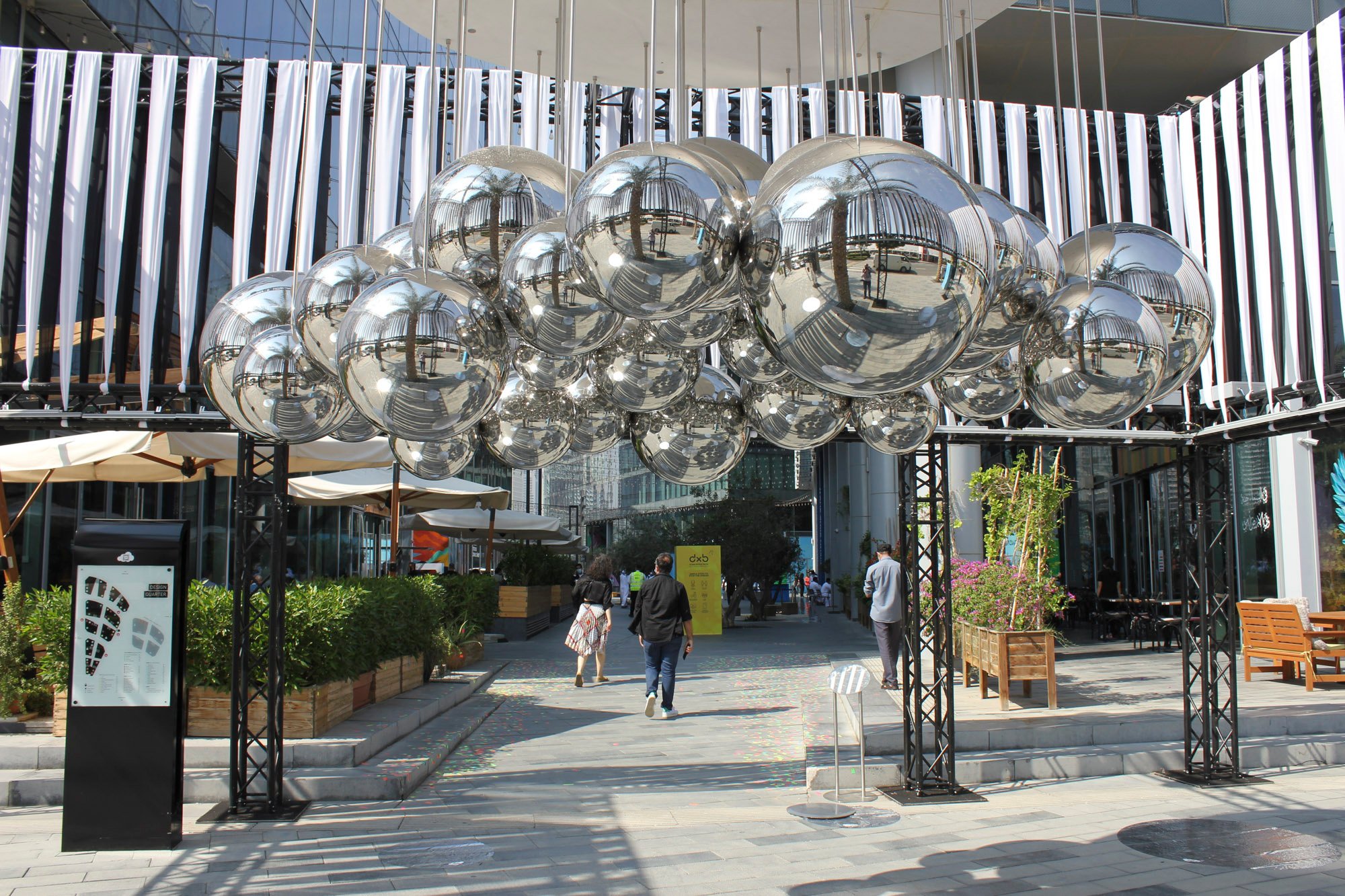
The principal outdoor commission comes from NAO Architects, the Dubai practice founded in 2023 by the architect Reem Nassour, which won this year’s Urban Commissions competition. The theme, Atmospheres, asks how light, temperature, sound and materials shape the experience of public space, and Three Gardens and a Room answers with three connected gardens around a central room, drawing on four architectural elements, the roof, the mound, the hearth and the enclosure. Planting, colour and filtered light give each garden its own character, and the movement of the sun changes them through the day.
For anyone planning the garden of a private villa, the lessons are practical ones. In the Gulf, the depth of shade, the orientation of a seat and the movement of air decide how comfortably an outdoor space is used, and Nassour’s project lets visitors feel those decisions at the scale of a garden.
Installations at Dubai Design Week
Several of the other installations look to traditional building and the arrangement of the home. CHATAI 2.0, by the Japanese practice Nikken Sekkei with SOBOKUYA, develops the timber teahouse the two firms showed last year, joined by traditional carpentry, with a programme of tea ceremonies, flower arranging and calligraphy and a path hung with 88 furin, the Japanese wind bells.
BAYN, by Bahrain’s Palm & Palazzo Design Studio, begins with the dikka, the bench built along the outside wall of a Bahraini house, from which residents could greet neighbours and watch the street while the home behind them stayed private. It is a small piece of architecture with a long reach. Entrances, courtyards and majlis spaces across the Gulf have long been arranged to manage the same balance between welcome and privacy.
Archaeology inspires Everyday Artifacts, by Noora Jabir and Moufida Mohideen, winners of the Christo and Jeanne-Claude Award 2026. Its starting point is Tell Abraq, the ancient settlement on the border between Sharjah and Umm Al Quwain, and its principal form is a fishing hook, partially buried, of the kind used by the region’s coastal communities some 4,000 years ago. Elsewhere, Taqleem, by the Emirati-Jordanian architect Rasha Saffarini, draws on the trimming of date palms to make a communal space.
The UAE Designer Exhibition: Inherited Futures
Indoors, the UAE Designer Exhibition returns to Downtown Design with work by 30 UAE-based creatives. Supported by Dubai Culture and conceived by the architect and designer AlZaina Lootah, this year’s edition, Inherited Futures, asks how materials, techniques and cultural practices can be carried into contemporary furniture, lighting and objects, and sets the work in what it calls a Majlis of the Future.
Rand Tayfour takes the structure of classical Arabic poetry as the basis for a series of majlis tables, and Kinda Ghannoum combines Arabic calligraphy and traditional pattern with digital pixel art in a collection of carpets. NUMU has made a chair from mycelium and date-palm waste, and Eman Shafiq sets her own Biosand material against pink onyx in lamps inspired by drifting desert sand. For anyone commissioning furniture for a home, it is a good place to start.
Downtown Design and Memphis
Downtown Design runs from 4 to 8 November. Among this year’s names are the Venetian glassmaker Venini, the outdoor furniture house Ethimo and the German appliance maker Gaggenau, while Kohler collaborates with the Dubai-based architect and designer Agata Kurzela, and Buccellati presents a collaboration with the British artist and designer Luke Edward Hall. The regional programme includes Tashkeel’s Tanween Design Programme and the Athath Fellowship, and talks at The Forum include the interior architect Tristan Auer, whose work includes the restoration of Burj Al Arab.
For collectors, the exhibition to see is Memphis Milano. The movement formed in Milan around Ettore Sottsass and showed its first collection in 1981, setting coloured laminates, exaggerated geometry and unexpected materials against the restraint of modernist furniture. It divided opinion at first and is now a recognised field of twentieth-century collecting.
David Bowie was among its early admirers. In November 2016, Sotheby’s London offered his collection in Bowie/Collector, a three-part sale that included a dedicated auction of Sottsass and the Memphis Group. Among the lots was Sottsass’s Casablanca sideboard, designed for the first Memphis collection, its angled shelves of plastic-laminated wood far removed from conventional cabinetmaking. The example carried its original Memphis Milano maker’s label and, estimated at £3,000–5,000, sold for £68,750.
Details of that kind are what separate one piece from another. An early production piece, a later edition and a unique commission may share a design yet differ entirely in history and collecting significance, and maker’s marks, provenance, materials and condition all deserve close attention, particularly where furniture has been repaired or restored. The same thinking runs through Dubai Sotheby’s International Realty’s Journal feature on the city’s designer penthouses, where collectible furniture and specialist makers shape the character of a residence.
Goldsmithing Across the Centuries
L’ÉCOLE, School of Jewelry Arts, presents Recreating Gesture: Crafting a Gold Necklace from the Iron Age, built around the reconstruction of a Celtic gold torque from the Second Iron Age, between around 450 and 25 BC. Through experimental archaeology, the master chaser Antoine Legouy, the archaeologist and goldsmith Barbara Armbruster and Grégory Weinstock, Director of High Jewellery Métiers at Van Cleef & Arpels, set out to understand how the original makers prepared, shaped and finished the gold with the tools of their time.
In Dubai, the exhibition also draws connections with Saruq Al Hadid, the ancient metalworking site in the desert south of the city. For collectors of antique jewellery the questions are familiar ones, since knowing how a piece was made is often the surest guide to its age, its workmanship and its authenticity.
Visiting Dubai Design Week 2026
At Dubai Design District, near Downtown Dubai and Business Bay, the principal installations and exhibitions are generally open from 10am to 10pm. Downtown Design has its own registration, and over the weekend of 7 and 8 November the Marketplace brings independent makers from the UAE and the region to d3. The outdoor installations are at their best in the late afternoon, when light and shade begin to shift.
When the week is over, most of the structures in d3 will be taken down. Taleem was designed for that moment, its reclaimed beams made to come apart and be assembled again elsewhere, which makes its joints as worth studying as the weavers’ code behind it.