---
title: "Top Dubai Landmarks to Visit in 2026: A Curated Guide"
description: Discover Dubai’s top landmarks in 2026, from Burj Khalifa to Museum of the Future. A curated guide to the city’s most iconic attractions.
image: https://blog.sothebysrealty.ae/hubfs/dubai%20landmarks.jpg
---
- [Home](https://sothebysrealty.ae/)
- [The Journal](https://sothebysrealty.ae/the-journal/)
- [Guides](https://sothebysrealty.ae/the-journal/tag/guides/)
Dubai is a city that understands the art of superlative architecture. Within a relatively small stretch of land, you'll find the world’s tallest building, the largest observation wheel, and a museum so structurally complex it required entirely new engineering methods to realise. Behind the scale of it all lies serious cultural capital, from the sandstone *barjeels *and narrow alleyways of Al Fahidi Historical Neighbourhood to the glow of Arabic poetry across the Museum of the Future. Whether you’re visiting Dubai for the first time, or a local looking to connect deeper with the city, here are six landmarks worth adding to your itinerary.
## 1. Burj Khalifa
The Burj Khalifa has held the title of the [world's tallest building](https://sothebysrealty.ae/the-journal/tallest-building-in-the-world/) since 2010, stretching a vertiginous 828 metres into the sky. The postcard picture of new Dubai, this is a landmark you can spot from anywhere in the city. Designed by Adrian Smith at Skidmore, Owings & Merrill, the tower's Y-shaped floor plan draws from the Hymenocallis desert flower, with a tapering form designed to reduce wind load. Inside, you'll find the five-star Armani Hotel Dubai, [Michelin-rated restaurants](https://sothebysrealty.ae/the-journal/michelin-star-restaurants-dubai/), corporate suites, upscale health clubs, and a number of luxury residences, including the exclusive [Armani Residences](https://sothebysrealty.ae/project/armani-beach-residences-palm-jumeirah/).
To really soak in its magnitude, skip the standard observation deck and head to At The Top SKY on level 148 – the highest deck in the building, which opens to breathtaking views over the entire city and coastline. On level 122, dinner with a view is taken to new heights at At.mosphere, a French fine-dining restaurant lauded in the Michelin guide.
## 2. Burj Al Arab
Before Burj Khalifa, there was Burj Al Arab: the iconic, sail-shaped hotel that first put Dubai on the global map. Opened in 1999 and designed by Tom Wright of WKK Architects, the tower stands on its own artificial island and is architecturally inspired by the sail of a traditional dhow. It’s currently the sixth tallest hotel in the world, standing at a spectacular 321 metres. The interiors here are unapologetically maximalist, with gold leaf ceilings, sweeping atrium lobbies, and a personal butler assigned to every suite. Dining spans nine venues, including Sahn Eddar – one of Dubai’s most opulent afternoon teas – and Bab Al Yam, which celebrates local Gulf flavours on the seafront.
## 3. Al Fahidi Fort
Al Fahidi Fort is Dubai’s oldest and most regal landmark, built circa 1787. Now home to the Dubai Museum, this peaceful, sandstone bastion has watched the city transform from a modest pearling village into the great metropolis we know it as today. Inside, you’ll find dioramas, archaeological finds, and pearl diving exhibits that trace the full arc of that transformation. The fort sits at the edge of Al Fahidi Historical Neighbourhood – a rare, largely intact pocket of old Dubai, with wind towers, coral-and-gypsum walls and narrow lanes that lead down to the Creek. After exploring Al Fahidi, you can cross over Deira by abra for a view of the city that’s less photographed.
## 4. Dubai Frame
Completed in 2018, Dubai Frame is a deeply symbolic landmark located in Zabeel Park. The structure itself is exactly what it sounds like: a giant picture frame with two vertical towers connected by a glass-floor sky bridge. Face toward the north and you're looking at historic Dubai (Deira, the Creek, Al Fahidi); face south and the skyline shifts to glass and steel, anchored by [Downtown](https://sothebysrealty.ae/community-guides/dubai/downtown-dubai/) and the Marina. Designed by architect Fernando Donis, it's a neat metaphor for a city in permanent transition, compressing the old and new into a single vantage point.
The Sky Deck (or Sky Walk) is the highlight, but there’s also a small exhibition that imagines Dubai several decades from now, with speculative displays on future transport, architecture, and urban life. Book tickets in advance and visit at dusk for the best views on both sides.
## 5. Museum of the Future
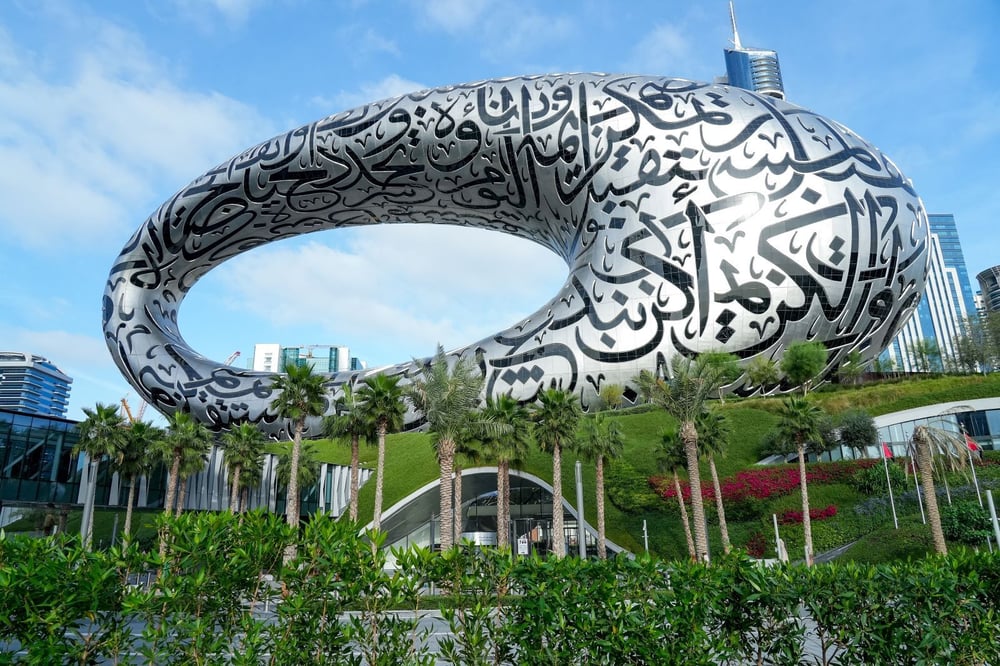
The dazzling Museum of the Future is an extraordinary feat of postmodern architecture along Sheikh Zayed Road. Engineered by Buro Happold and designed by Killa Design – the architects behind [Jumeirah Marsa Al Arab](https://sothebysrealty.ae/buy/dubai/property-for-sale-jumeirah-jumeirah-3-marsa-al-arab/) and The Address Beach Resort – it’s widely regarded as one of the most structurally complex buildings ever constructed. The façade was realised using AI-led algorithms and parametric modelling, wrapped in 1,024 uniquely shaped stainless steel panels engraved with Arabic calligraphy from the writings of Sheikh Mohammed bin Rashid Al Maktoum.
This Dubai landmark isn’t a museum in the traditional sense; set in the year 2071, the museum takes visitors through a series of possible futures. The visitor path begins on the fifth floor aboard the OSS Hope – a simulated orbital space station exploring how humanity might live and work beyond Earth. From there, visitors descend to The HEAL Institute, dedicated to restoring the planet's ecosystems through biotechnology and regenerative science. The third floor, Al Waha, offers a grounding change of pace: a sensory oasis of sound, touch and stillness.
## 6. Ain Dubai
Standing at 250 metres, Ain Dubai is the world's tallest observation wheel – twice the size of the London Eye. Since opening in 2021, it's become the focal point of Bluewaters Island – a purpose-built leisure destination just off the [Jumeirah Beach Residence](https://sothebysrealty.ae/community-guides/dubai/jumeirah-beach-residence/) coastline. The views at the top are extraordinary: the fronds of [Palm Jumeirah](https://sothebysrealty.ae/community-guides/dubai/palm-jumeirah/) in perfect formation, the Marina skyline, and the blue open expanse of the Arabian Gulf. A full rotation takes a leisurely 38 minutes, with space for up to 40 passengers in each cabin.
For a more elevated visit, Ain Dubai offers a range of private cabin experiences, including a five-course dinner with craft cocktails, traditional High Tea with champagne, and occasional themed nights. Beyond the wheel, Bluewaters Island has a handful of venues worth exploring afterwards, including Brass Monkey, The Spaniel, and Madame Tussauds.
#### Read More
Related news
[ ](https://sothebysrealty.ae/the-journal/short-term-vs-long-term-rentals-in-dubai/)
[Guides](https://sothebysrealty.ae/the-journal/tag/guides/)
[Short-Term vs Long-Term Rentals in Dubai: How Each Market Works for Investors
](https://sothebysrealty.ae/the-journal/short-term-vs-long-term-rentals-in-dubai/)
July 2nd, 2026 / 5 min. read
[ ](https://sothebysrealty.ae/the-journal/best-tea-houses-in-dubai/)
[Guides](https://sothebysrealty.ae/the-journal/tag/guides/)
[Best Tea Houses in Dubai
](https://sothebysrealty.ae/the-journal/best-tea-houses-in-dubai/)
July 2nd, 2026 / 5 min. read
[ ](https://sothebysrealty.ae/the-journal/jacob-and-co/)
[Guides](https://sothebysrealty.ae/the-journal/tag/guides/)
[Jacob & Co.: The Jewellery House That Turned Horology into Architecture
](https://sothebysrealty.ae/the-journal/jacob-and-co/)
July 2nd, 2026 / 4 min. read
[ ](https://sothebysrealty.ae/the-journal/pool-bars-in-dubai/)
[Guides](https://sothebysrealty.ae/the-journal/tag/guides/)
[Pool Bars in Dubai: Lush Poolside Days in the Sun
](https://sothebysrealty.ae/the-journal/pool-bars-in-dubai/)
July 1st, 2026 / 4 min. read
[ View All ](https://sothebysrealty.ae/the-journal/)
```json
{
"@context" : "https://schema.org",
"@type" : "BlogPosting",
"author" : {
"@type" : "Person",
"name" : "Admin",
"url" : "https://blog.sothebysrealty.ae/the-journal/author/admin"
},
"dateModified" : "2026-04-08T07:29:45.932Z",
"datePublished" : "2026-04-08T07:29:34.000Z",
"headline" : "Top Dubai Landmarks to Visit in 2026: A Curated Guide",
"image" : [ "https://blog.sothebysrealty.ae/hubfs/dubai%20landmarks.jpg" ],
"mainEntityOfPage" : {
"@id" : "https://blog.sothebysrealty.ae/the-journal/dubai-landmarks",
"@type" : "WebPage"
},
"publisher" : {
"@type" : "Organization",
"logo" : {
"@type" : "ImageObject",
"url" : "https://blog.sothebysrealty.ae/hubfs/Dubai_SIR_Horz_BLU-1.png"
}
}
}
```