Published: 1 April 2026
Dubai has long been a destination favoured by business travellers, families seeking a vacation getaway, and even the occasional celebrity. Its reputation for five-star hospitality has been shaped by a collection of hotels that are precursors to modern icons such as the Atlantis, Atlantis the Royal and JW Marriot Marquis properties.
Set along the Creek, near the airport and across the early stretches of Jumeirah, these addresses were instrumental in defining the city’s service culture and adapting it to an increasingly global clientele. They hosted business delegations, royal dinners, weddings, conferences, long lunches and early fine-dining rituals.
Today’s grand resorts and contemporary five-star openings can be seen as a continuation of that legacy. The city has grown taller, wider and more ambitious, but its instinct for welcome was formed much earlier. The following hotels show where that story began, and why these landmark addresses still matter today.
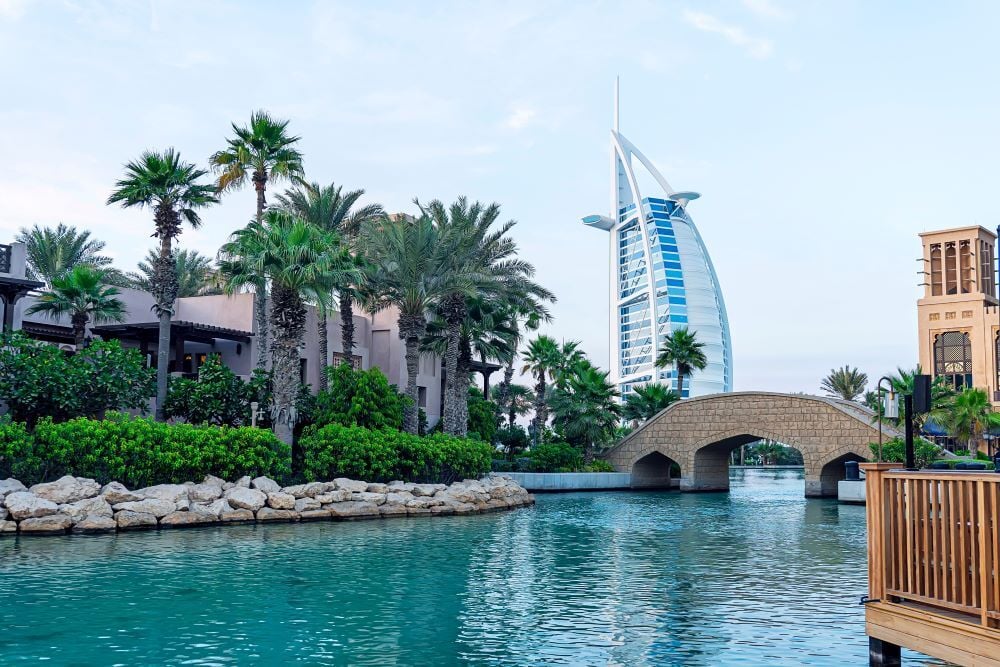
image credit: Melnikov Dmitriy / Shutterstock.com
Radisson Blu Hotel, Dubai Deira Creek
On Baniyas Road, beside one of Dubai’s most famous waterways, Radisson Blu Hotel, Dubai Deira Creek offers a traditional counterpoint to the city’s newer hotel districts. Operating since 1975, when it was known as the InterContinental Dubai, it is widely regarded as Dubai’s first five-star hotel and remains one of the clearest survivors from the city’s early modern hospitality period.
Its position matters. Long before the beach resorts, Downtown towers and marina skyline, the Creek was Dubai’s commercial heart: a place of dhows, souks, banks, consulates and trading houses. The hotel gave that world an international address. Its balconies looked towards the water, its restaurants became meeting places, and its presence helped establish the idea that Dubai could host business travellers and visiting guests with the polish expected in older global capitals.
Much has changed since then, including the name, interiors and the city around it. Yet the hotel still carries a particular kind of memory. It is associated with early fine dining, long-serving staff, loyal regulars and hotel rituals that pre-date much of modern Dubai. Shabestan, its Persian restaurant, remains one of its best-known dining rooms, while the Creek-facing setting gives the property a sense of continuity that is not easily replicated.
Sheraton Dubai Creek Hotel & Towers
Positioned on Dubai Creek since 1978, Sheraton Dubai Creek Hotel & Towers added another important layer to the city’s early hotel identity. From its waterside address, it helped strengthen Deira’s role as a centre of business, travel and formal hospitality, at a time when the Creek still held much of Dubai’s commercial life close to the water.
The hotel’s character has always been tied to that setting. Its façade, height and Creek-facing position made it a visible part of old Dubai’s skyline before the city’s later towers changed the scale of almost everything around it. The affectionate nickname “Lady of the Creek” still suits it rather well, capturing both its age and its gentler place in the city’s memory.
Modernisation has brought the property forward, but its strongest asset remains continuity. The hotel belongs to a Dubai of shipping, trade, diplomatic travel and proper hotel service. For long-time residents, it is often linked to dinners, weddings and business meetings; for visitors, it offers a view of the city before themed beach resorts and super-tall towers took over the imagination.
With its Creek-side position, international hotel heritage and long local memory, Sheraton Dubai Creek remains as good a place as any to begin tracing how Dubai’s five-star hospitality culture first took shape.
Le Méridien Dubai Hotel & Conference Centre
For a more spacious early five-star address, Le Méridien Dubai Hotel & Conference Centre brought a different kind of luxury to the city. Opened in 1979 beside Dubai International Airport, it was not shaped by Creek views or beachfront leisure, but by access. That location gave it a practical role in Dubai’s growth, particularly for business travellers, airline guests and visitors moving through the city.
The hotel is larger in scale than many of Dubai’s older central properties, spread across 15 hectares of gardens with rooms, restaurants, meeting facilities and generous outdoor space. Its character comes from that combination: close to the airport, but not merely an airport hotel; built for conferences and stopovers, but with enough restaurants, lawns and resort-style facilities to make longer stays feel comfortable.
Over time, its food and beverage offer became a notable part of the address, helping the hotel serve residents as well as travellers. Business lunches, conferences, repeat visits and overnight stays before onward travel all gave Le Méridien a place in Dubai’s working hospitality culture.
Le Méridien shows how early Dubai understood the value of a good base – space, comfort and swift access in one place. Not every grand hotel needed a beach or a Creek view; some mattered because they helped the city run that bit more smoothly.
Hyatt Regency Dubai
Another important address from Deira’s early five-star generation, Hyatt Regency Dubai put guests within easy reach of the Creek, the souks and the older trading districts. Positioned on the Deira Corniche, it brought a larger international hotel format to the city, with a more self-contained feel than many of Dubai’s earlier properties.
The hotel became closely associated with two features that made it part of the experience for residents as much as guests: Al Dawaar, Dubai’s rooftop revolving restaurant, and the ice rink within The Galleria complex. In 1980, long before observation decks and skyline dining became familiar parts of Dubai’s hospitality offer, a revolving restaurant felt properly novel. Dinner came with changing views of the Gulf, the Creek and the city around it — a small flourish, but a memorable one.
The ice rink added another layer. Long before Dubai became known for indoor skiing, vast malls and all-weather leisure, Hyatt Regency had already shown how a hotel could hold more than rooms, restaurants and meeting spaces. It offered recreation within the building itself, giving guests and residents another reason to visit.
With its Corniche address, revolving restaurant and indoor leisure element, Hyatt Regency Dubai helped establish the idea of the hotel as a world of its own.
Jumeirah Beach Hotel
By the late 1990s, Dubai’s luxury hotel story was moving decisively towards the coast. Opened in November 1997, Jumeirah Beach Hotel became one of the strongest signs of that shift with a home-grown resort landmark, a wave-inspired form and a role in launching Jumeirah as the city’s own international luxury hotel brand.
Unlike the Creek hotels, this was not an address built around trade, diplomatic travel or early business life. Set along the Jumeirah shoreline, it offered a fresh take on Dubai hospitality, shaped by beachfront leisure, family holidays and a more visual idea of the city. Its curved profile made the building instantly recognisable, giving Dubai a resort image that could be read at a glance.
The hotel became closely tied to the wider Jumeirah coastal experience. Its position beside Wild Wadi and near Burj Al Arab later placed it within one of Dubai’s most familiar hospitality clusters, with beach, waterpark, dining and landmark architecture all close together. For families and visiting guests, it helped make the coast feel like a complete destination rather than a single hotel stay.
The Ritz-Carlton, Dubai
Opened in 1998, The Ritz-Carlton, Dubai arrived on the Jumeirah coast before Jumeirah Beach Residence, Dubai Marina, Bluewaters and the wider leisure district around it had taken shape. Today it sits within one of Dubai’s busiest waterfront areas, but its beginnings belong to a quieter stretch of coastline.
The hotel followed a low-rise resort model, with gardens, courtyards, beachfront access and a more private sense of arrival. It did not depend on height or visual drama. Instead, it brought an established international luxury name to the Jumeirah shore and gave the area a traditional resort presence before the Marina became a dense urban district.
Its role in Dubai’s old five-star story is one of refinement rather than spectacle. In a city where many coastal hotels are much newer, The Ritz-Carlton, Dubai remains one of the original luxury beachfront stays, and a rare piece of pre-Marina hospitality history.
Jumeirah Burj Al Arab
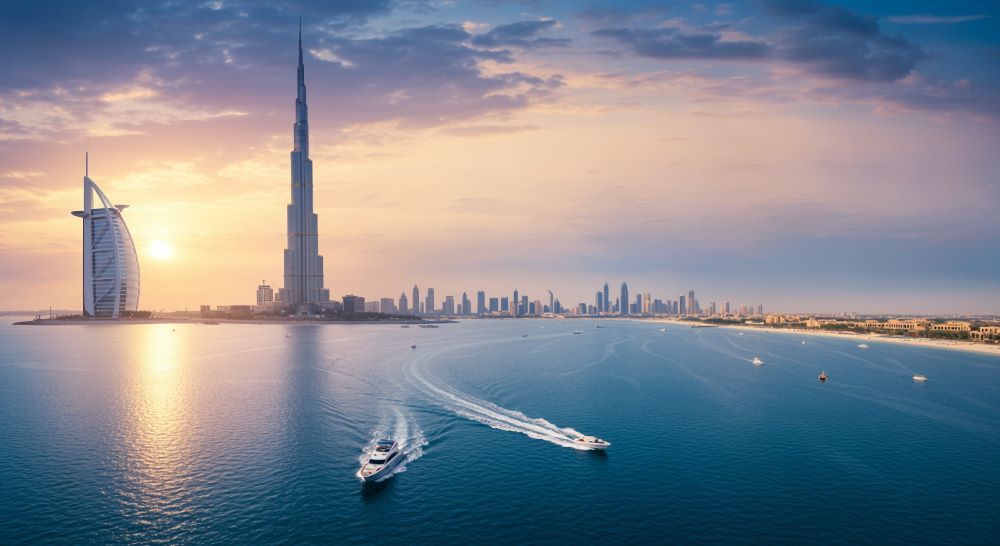
By the end of the 1990s, Dubai’s hotel story had moved from the Creek to the coast in unmistakable fashion. Opened in 1999, Jumeirah Burj Al Arab gave that shift its most recognisable form: a sail-shaped hotel, built on its own island, and designed to be remembered long before a guest reached the lobby.
Its place in this list is different from the earlier Deira hotels. Radisson Blu Deira Creek belongs to the city’s first five-star age, close to souks, trading boats and the working water of old Dubai. Burj Al Arab arrived with a different kind of confidence. It was not simply selling rooms; it was selling an image of Dubai that could travel easily, appearing in magazines, postcards, television reports and, later, almost every visual shorthand for the city.
The hotel’s all-suite format, formal service and lavish interiors made it one of the most discussed luxury hotels of its time. As a closing point, it gives the timeline a neat contrast. In 1975, Dubai’s first five-star hotel stood beside the Creek, close to trade and everyday movement. By 1999, a sail-shaped hotel stood offshore on the Jumeirah coast, built to be photographed, recognised and remembered. Between those two addresses sits the early story of Dubai’s rise as a luxury hotel city.