Published: 9 March 2026
Dubai’s skyline did not emerge fully formed. Like many great cities, it evolved through a series of moments in which ambition, necessity and opportunity shaped the urban landscape that defines it today. In earlier decades, the city’s built environment reflected the practical needs of a coastal trading port, where modest structures and traditional materials defined everyday life.
As Dubai expanded and its aspirations widened, architecture began to evolve with it, gradually giving rise to a skyline that now ranks among the most recognisable in the world. In little more than three decades, Dubai has assembled a collection of landmarks that do more than shape the horizon. They organise districts, attract international visitors and quietly influence how the city is perceived across the globe.
Emirates Towers
One of the earliest examples of this transformation is Emirates Towers, located along Sheikh Zayed Road and completed in 2000. The complex consists of two slender triangular towers rising approximately 355 metres and 309 metres, sharing a landscaped podium that connects offices, hospitality and dining venues. Designed by architect Hazel Wong at NORR, the project arrived at a moment when Dubai’s skyline was beginning to move confidently upward.
The towers helped establish a new model for the city’s business districts. Rather than separating commercial and hospitality functions, Emirates Towers brought them together within a single development. Offices, a luxury hotel and public-facing restaurants exist together within the same development, creating a destination that serves both business activity and everyday city life. While the towers themselves are not designed as observation attractions, the surrounding boulevard and dining terraces have become lively gathering spaces that connect the complex with the wider rhythm of Sheikh Zayed Road.
Burj Khalifa
A decade later, Dubai introduced a structure that would change the way the world measured urban ambition. Burj Khalifa, completed in 2010, rises 828 metres and remains the tallest building ever constructed. Designed by Skidmore, Owings & Merrill, the tower reflects a moment in which engineering and architectural thinking evolved together. Its distinctive Y-shaped plan and buttressed core structural system allow the building to distribute wind and gravity forces efficiently, enabling it to reach unprecedented height while maintaining remarkable stability.
Yet the story of Burj Khalifa extends well beyond its engineering achievements. From observation decks high above the city, visitors can see Dubai from a perspective that reveals the scale of its transformation. The skyline stretches across the horizon, the coastline curves toward the open sea, and the city’s expanding districts unfold in every direction. Below, fountains, promenades and retail avenues create spaces where people gather, walk and experience the city at street level.
In this way, Burj Khalifa functions as more than a vertical landmark. It anchors an entire urban environment, illustrating how architecture in Dubai often becomes part of a wider story about place, ambition and the evolving character of the city.
The Palm Tower
As Dubai expanded beyond its traditional centre, new landmarks began to emerge across its coastal districts. Among them is The Palm Tower, completed in 2020, which rises 231.5 metres above Palm Jumeirah. Positioned at the heart of the island’s trunk, the tower brings together luxury residences, hotel accommodation and leisure spaces within a single vertical development.
Designed with contributions from Gensler and RSP Architects Planners & Engineers, the building also introduced The View at The Palm, an observation experience that opened in 2021. From roughly 240 metres above sea level, visitors can clearly see the island’s distinctive palm-shaped design. The fronds extend outward into the surrounding waters, the crescent breakwater forms a protective arc, and Dubai’s skyline appears on the horizon beyond the water.
In this sense, The Palm Tower reflects a broader architectural idea in Dubai, where height represents not only ambition but also reveals new perspectives on the city and its landscape.
Burj Al Arab
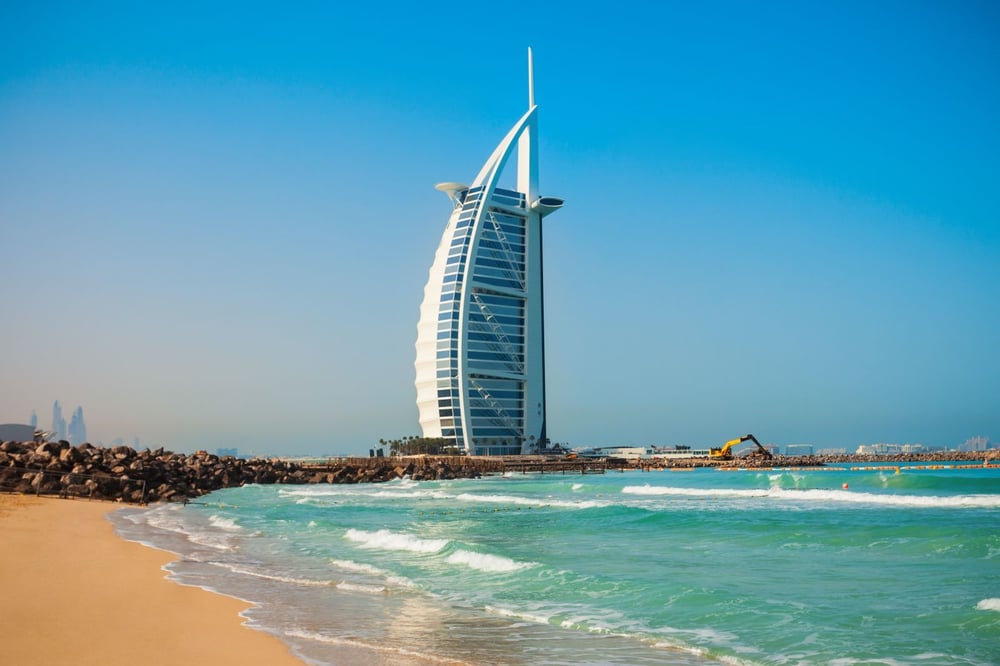
Completed in 1999 along the Jumeirah coastline, Burj Al Arab came to be recognised as one of Dubai’s most recognisable architectural emblems. Rising 321 metres above the sea on its own artificial island, the hotel was designed by Tom Wright of Atkins as a singular luxury destination. Its distinctive sail-like silhouette, often compared to the sail of a traditional dhow, reflects the maritime heritage that once defined the region’s coastline. Positioned offshore, the building was carefully conceived so that its form would remain unobstructed against the open horizon, allowing it to stand apart as a landmark visible from miles along the coast.
Inside, a vast atrium rises through the centre of the building, among the tallest hotel interior spaces in the world, with balconies and suspended walkways lining its walls like terraces within a vertical landscape. High above the shoreline, a helipad positioned approximately 210 metres above ground further accentuates the building’s dramatic presence against the skyline.
In recent years, the experience of Burj Al Arab has gradually evolved. While it remains one of the world’s most exclusive hotels, curated experiences such as the “Inside Burj Al Arab” tour now offer visitors a glimpse into its architecture and design while preserving the hotel’s long-standing sense of exclusivity.
Jumeirah Beach Hotel
Just a short distance along the same coastline stands Jumeirah Beach Hotel, completed in 1997 and designed by Atkins. Rising roughly 104 metres across 26 floors, the building introduced a very different architectural gesture. Its sweeping curved façade resembles a breaking wave, forming a striking counterpart to the sail-shaped Burj Al Arab nearby.
The design reflects a careful relationship between architecture and location. By shaping the building in a broad curve, the hotel ensures that most rooms face the sea, aligning the structure directly with the experience it offers: uninterrupted coastal views and immediate access to the beach. Today the property contains 599 sea-facing rooms and suites, along with a collection of villas and resort facilities designed for both leisure travellers and families.
Beyond its hospitality offering, Jumeirah Beach Hotel played an important role in the evolution of Dubai’s international image. At a time when the city’s skyline was still relatively modest, its distinctive silhouette, together with that of Burj Al Arab, created one of the most recognisable architectural compositions along Dubai’s coastline.
Museum of the Future
Opened on 22 February 2022 along Sheikh Zayed Road, the Museum of the Future stands among the most distinctive architectural landmarks of Dubai’s contemporary skyline. Created by Killa Design with engineering by Buro Happold, the building takes the form of a vast torus rising approximately 77 metres, its stainless-steel exterior composed of 1,024 individually fabricated panels that together form flowing Arabic calligraphy across the façade.
Inside, the museum reflects Dubai’s growing interest in science, innovation and technological exploration. Organised across five primary exhibition floors, the interior hosts immersive installations examining themes such as space exploration, artificial intelligence and climate innovation, alongside spaces for events and educational programmes.
Supporting the building’s complex geometry is a diagrid structural framework, allowing the curved form to remain stable while distributing weight efficiently. The calligraphic openings double as windows, drawing natural light into the galleries.
Dubai Opera
Where many of Dubai’s landmarks are defined by height, Dubai Opera reflects the city’s growing cultural ambitions. Opened on 31 August 2016 within the Opera District of Downtown Dubai, the venue sits beside the Burj Khalifa lake, contributing a different architectural rhythm within the surrounding skyline.
Developed by Emaar Properties and designed by Atkins, with Janus Rostock as lead architect, the building takes inspiration from the form of a traditional dhow, echoing the maritime vessels that once travelled the region’s waters.
The venue accommodates roughly 2,000 seats, yet its defining feature lies in its adaptability. The auditorium can transform between theatre, concert hall and flat-floor event space, allowing the building to host opera, orchestral performances, theatre productions and large-scale events. Standing about 44 metres high, Dubai Opera creates a cultural focal point within Downtown Dubai.
Dubai Frame
Within Zabeel Park, the Dubai Frame offers one of the city’s most symbolic architectural experiences. Opened in 2018, the structure rises 150 metres in height and 95 metres in width, forming a monumental frame that visually captures two eras of Dubai’s development.
From the Sky Deck, visitors can look north toward the historic districts of Deira and Bur Dubai, where the city’s early trading life unfolded. Turning south reveals the contemporary skyline stretching along Sheikh Zayed Road, placing Dubai’s past and present within a single frame.
Clad in gold-coloured stainless steel, the structure is reached by lifts rising the equivalent of 48 floors in roughly 75 seconds. At the top, a glass-floored bridge spans the two towers, allowing visitors to walk between the two towers while suspended above the park below. The concept originated from an international architectural competition, often associated with architect Fernando Donis, and the completed monument has since become one of the city’s most photographed landmarks.