Published: 2 July 2026
Jewellery houses deal in precious objects made to be worn, kept, and passed down, where detail and setting can be as telling as the stones themselves. That discipline gave Jacob & Co.’s move into watchmaking a natural direction. From its beginnings in New York jewellery, the house moved into high watchmaking, where complex movements, sculptural cases, and intricate gem-setting became part of its DNA.
A distinct thread runs through its most recognisable pieces. Diamonds, tourbillons, rotating planets, miniature engines, and highly constructed dials do more than decorate; they shape the watches’ structure, movement and display, giving the watchmaking a more constructed, studio-like quality.
Seen in this way, Jacob & Co.’s role in Burj Binghatti feels entirely in keeping with the house’s design history. The Dubai tower draws on the jeweller’s approach to cut stones, carrying facets, polish and vertical display into the skyline. The house is still best known for objects worn on the wrist or set in jewellery, but here, one of its design ideas has been given architectural scale.
The Career of Jacob Arabo
Jacob Arabo founded Jacob & Co. in New York in 1986, after establishing himself in the city’s jewellery trade. That early training shaped the house’s later move into horology, giving its watches a different starting point from brands rooted mainly in movement-making. Stones, setting, proportion and personal commission remained part of the design discipline, even as the work became more mechanically complex.
It also gave the company a very particular design eye. Arabo built his name around jewellery with a strong visual identity, often made for private clients looking for pieces beyond inherited convention. His later watches followed the same line of thought, favouring colour, movement, scale and gem-setting over the quieter codes of traditional Swiss watchmaking. It helped the brand claim a recognisable place of its own, even when its work sat outside more conservative taste.
The Five Time Zone watch, introduced in the early 2000s, became one of the first major Jacob & Co. watch signatures. Its travel-time function was practical, but the design was deliberately expressive, with colour, diamonds and changeable styling forming part of its character. It was made for a client moving between cities and time zones, with the watch acting as both instrument and calling card.
More complex pieces followed. Astronomia, Opera, Twin Turbo and the Bugatti-related watches all show Jacob & Co.’s continued interest in mechanical display. In many of these designs, the movement is not hidden behind the dial. It becomes the structure, the focus and the main design event.
A Watchmaker’s Jewellery Eye
At the centre of Jacob & Co.’s work is a close exchange between gem-setting and mechanics. Diamonds do more than decorate the surface. In many pieces, they shape the construction of the watch itself, from the case and bracelet to the way the object catches light and sits on the wrist.
The Billionaire collection makes that point clearly. In the Billionaire III, hundreds of emerald-cut white diamonds form much of the watch’s visual structure, rather than simply sitting on the surface. It is watchmaking treated through jewellery construction, with the stones shaping the piece as much as the movement.
That gives the house its particular design character. Its best-known creations lean towards scale, rarity and technical ambition, with the strongest pieces holding craft and mechanics in balance. The effect works best when the gem-setting and movement feel designed together from the outset, rather than one being added after the other.
Astronomia: A Planetary System for the Wrist
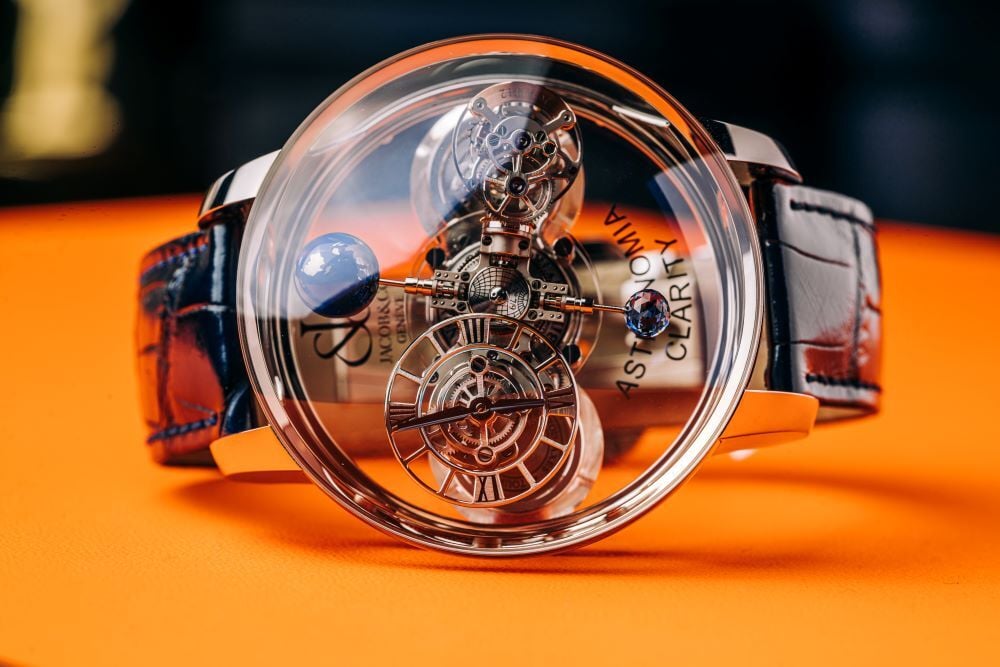
Few Jacob & Co. watches show the house’s unique design approach as clearly as Astronomia. Built around a rotating three-dimensional movement, the watch places timekeeping, tourbillon, globe and gem-set elements inside a large sapphire case, with each part given room to move and be seen.
The idea has a clear astronomical foundation. In the Astronomia Tourbillon, a vertical movement carries four satellite arms, creating the impression of small planetary bodies in motion. It is a watch designed around depth as much as surface, with the mechanics forming the structure of the piece rather than sitting quietly behind a dial.
Astronomia has since grown into a wider family, including Astronomia Sky and Astronomia Maestro, with astronomical, musical and artistic details added across different editions. It holds its place in the Jacob & Co. story because it brings together several of the house’s strongest instincts, including technical ambition, gem-setting, and a taste for highly constructed watches.
Opera Godfather: Cinema, Music and Mechanics
In the Opera Godfather, Jacob & Co. takes a film reference and gives it a mechanical form. Created as a tribute to The Godfather, the watch combines high watchmaking with a miniature music box, housed inside a 49mm case with visual and symbolic details drawn from the film.
The musical complication plays the film’s theme, while the case, movement and decorative elements are arranged around the same reference. It is not a quiet piece, but it has a clear design discipline: the cinema, the music and the mechanics are held together as one idea.
For the house, this is familiar ground in the best sense. The watch turns popular culture into a crafted object, with enough technical ambition to keep it within high watchmaking and enough character to make it part of the house’s design collection.
Bugatti in Mechanical Miniature
The Bugatti partnership gave Jacob & Co. another way to work with movement, engineering detail and finely worked mechanical form. Rather than relying on a logo or shared name, the watches draw from the structure and mechanics of the hypercar itself, bringing automotive references into high watchmaking with a sharper design approach.
The Bugatti Chiron Tourbillon is the strongest example, with a miniature engine animation that echoes the Bugatti W16. Later Bugatti-related pieces continued that link between car design and horology, using case construction, movement and mechanical display to suggest the uncanny pleasure of a machine reduced to wrist scale.
The fit between the two houses is easy to follow. Both are associated with rarefied objects, technical ambition and clients drawn as much to engineering as to finish. In these watches, the engine becomes more than a decorative cue; it gives Jacob & Co. one of its clearest links between mechanical craft and sculptural form.
From Watchmaking to Skyline
The clearest architectural turn in this story arrives in Dubai, where Burj Binghatti Jacob & Co Residences takes the jeweller’s interest in cut stones, mechanical rarity and vertical display into built form. Developed with Binghatti, the branded residential tower brings high horology, jewellery and real estate into the same brief, with project materials presenting it as a planned record-setting residential tower in Dubai.
At the apex, the reference becomes most direct. Binghatti describes a crown inspired by Jacob-cut gems, worked into an intricate lattice structure. The result is well-cut rather than merely decorative, with facets, polish and a lofty profile used as part of the tower’s form rather than surface styling.
The residences carry the same idea further. Names drawn from gemstones and Jacob & Co. timepieces, including the Astronomia Sky Mansion Penthouse and gemstone-named villas, carry the watch and jewellery references into the private homes. It is a literal move, perhaps, but a legible one, turning the house’s taste for finely worked objects into a rarefied residential address.
None of this makes Jacob & Co. an architect in the traditional sense. It does, however, show how far a strong design identity can stretch when the underlying idea is sturdy enough. In Burj Binghatti, the house’s diamonds, mechanics and collector-led sense of scale and rarity are adapted into architectural concepts.