Published: 29 October 2026
For decades, a pink gold Patek Philippe made in 1948 lay in a safe-deposit box. Its original Certificate of Origin, instructions and presentation case were kept alongside it. Its owner, Prince Tewfik Adil Toussoun of Egypt, had bought it in July 1951. It was one of the rarest variants of the reference 1518, with a pink dial matched to a pink gold case. When his heirs consigned it to Sotheby’s New York in December 2021, it sold for $9,570,900, more than four times its estimate. Sotheby’s recorded it as the only known 1518 still accompanied by all its original documentation.
The result says a good deal about how collectors judge a Patek. Reference numbers tell a buyer where to start, but the details that decide value are often small enough to need a loupe. For that reason, the most recognisable Patek is not always the most coveted. The strongest bidding goes, more often than not, to watches whose making, ownership and condition can be traced without a gap.
From Madinat Jumeirah to Saadiyat
Patek Philippe chose a pocket watch as the centrepiece of its first Watch Art Grand Exhibition, held at Madinat Jumeirah in Dubai in January 2012. The Star Caliber 2000 is a double-dialled watch of 1,118 components and 21 complications. It took nine years to develop, and Patek made it in only five sets of four.
One of those sets came to Sotheby’s inaugural Abu Dhabi Collectors’ Week in December 2025. According to the house, it was the first complete set ever offered at auction. Its four watches, in yellow gold, white gold, pink gold and platinum, sold together for $11.9 million against an estimate of $10–20 million.
Only one watch in Sotheby’s history has made more. The Henry Graves Supercomplication was delivered to the New York banker in 1933, a gold pocket watch with 24 complications. It realised CHF 23,237,000, or almost $28.2 million, in Geneva in November 2014, which remains the highest price paid at auction for a pocket watch.
The Calendar on the Wrist
For most collectors, the story moves to the wrist. Launched in 1941, the reference 1518 was the first perpetual calendar chronograph wristwatch made in series. It combines a stopwatch with a calendar that accounts for months of different lengths and for leap years. Sotheby’s puts total production at 281, with only 58 believed to have been cased in pink gold.
Its successor, the reference 2499, shows how narrowly rarity can be defined. One pink gold second-series example, made in 1957 and retailed by Gobbi Milano, is the only one known with a retailer’s signature on the dial. It sold at Sotheby’s Hong Kong in April 2022 for HK$60,265,000, about $7.7 million. When the same watch returned to Sotheby’s New York in June 2025, it realised $4,320,000.
Its rarity and provenance were unchanged, but its price had fallen by almost half. Collectors buy the object itself, and the figure reached on any single evening is, at best, a provisional verdict.
Nautilus, and the Trouble with Averages
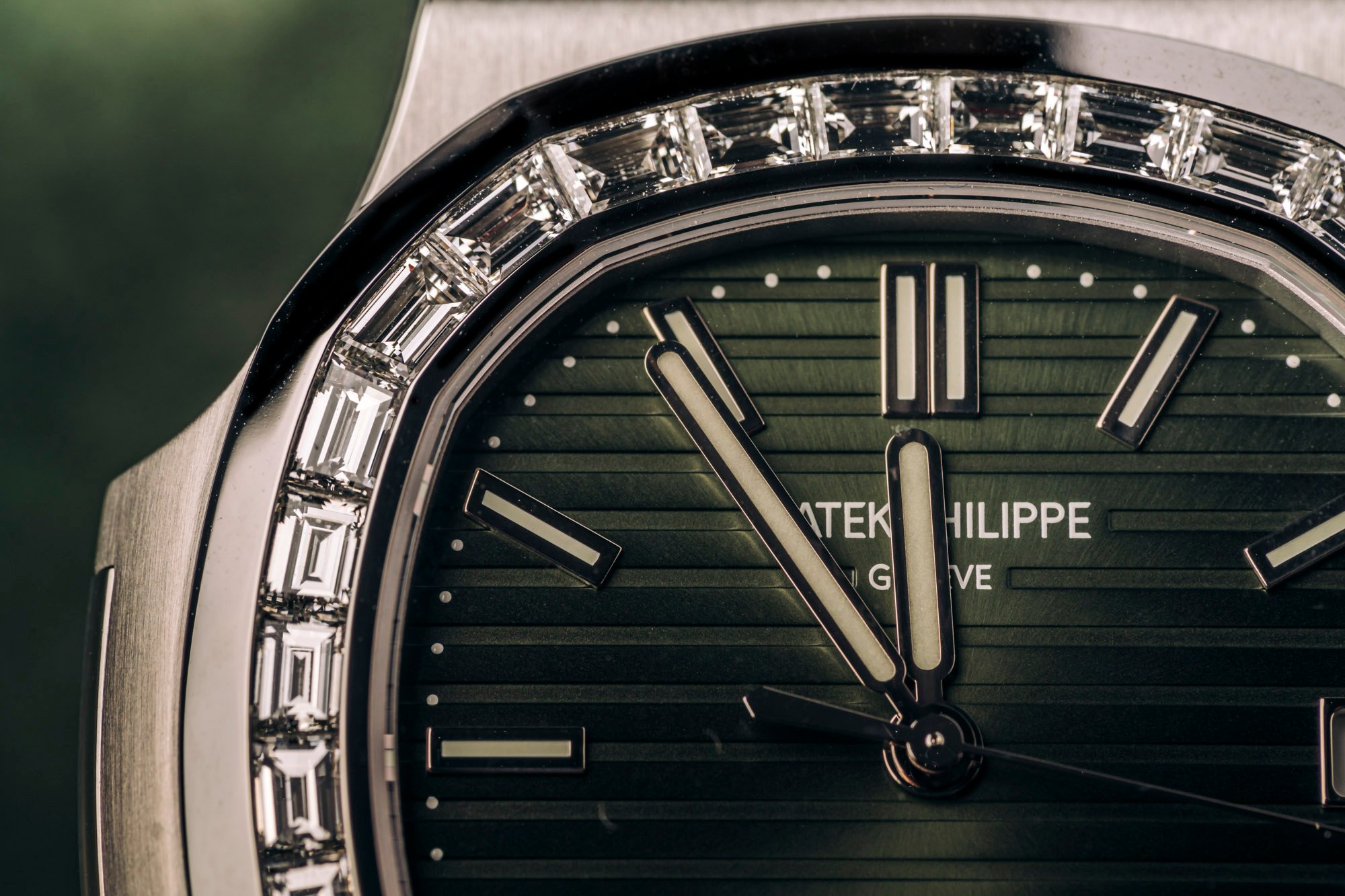
The most recognisable Patek of all arrived in 1976. Designed by Gérald Genta, the reference 3700/1A paired a porthole-inspired case with an integrated bracelet, all in stainless steel, which was an unusually bold step for the house. It stayed in production until 1990.
For the model’s thirtieth anniversary in 2006, Patek introduced the reference 5711. It refined the original outline without abandoning it, and moved from a two-piece to a three-piece case.
Within the 5711 family, the colour of the dial can put one watch in a different collecting category from another. Patek made a Tiffany Blue edition of 170 watches to mark 170 years of partnership with Tiffany & Co. One of them realised HK$20.4 million, or $2.6 million, at Sotheby’s Hong Kong in April 2023.
That figure belongs to a limited edition, not to the ordinary steel Nautilus. Anyone buying a Nautilus to wear would do well to keep the two markets apart, and to separate affection for the design from expectations formed in an unusually heated period of bidding.
London and the Enamelled Map
Patek Philippe has long-standing ties with Britain. To close its 175th-anniversary celebrations in 2015, the company held its Watch Art Grand Exhibition at the Saatchi Gallery in London. Over twelve days it drew more than 42,500 visitors, and Thierry Stern, the company’s president, described it as the largest exhibition Patek had ever staged.
Sotheby’s London has given particular attention to the World Time. Its Important Watches sale in October 2020 included the platinum reference 5131, whose cloisonné enamel dial is made by hand and recalls the world timers of the mid-twentieth century. The platinum version was the only one offered with a matching bracelet. Because enamel work keeps production low, collectors look closely at the subject of the map, the quality of its colours and the way they sit against the case metal.
For an owner who divides the year between the Gulf and Britain, the Aquanaut Travel Time reference 5164G meets a more practical need. Its two hour hands show local and home time, each with its own day-and-night indicator. Pushers on the flank of the case move the local hour forwards or back, and the date follows local time. With the watch set to Dubai, the hour in London stays in view without a second thought. In white gold, with a blue-grey dial and a matching composite strap, it wears its complication lightly.
The Calatrava, and the Case for Restraint
Not every serious collection is built on complications. The Calatrava dates back to 1932, when the reference 96 established the round dress watch at the heart of Patek’s range. Because the case leaves so little room for distraction, the proportions of bezel, markers and hands carry the whole design.
The modern reference 6119, introduced in 2021 in rose gold and white gold, surrounds its dial with a guilloched hobnail bezel. It houses a new manually wound movement with a 65-hour power reserve, enough to run for nearly three days off the wrist. A preference for so plain a dial can be every bit as considered as a fascination with a perpetual calendar, and it makes no demands on the owner beyond the habit of winding the watch.
Buying in Dubai
Sotheby’s has a gallery at Gate Village, in the Dubai International Financial Centre, since 2017. It held its first Middle East watch sale there the following year, preceded by an evening hosted with Dubai Sotheby’s International Realty.
Frédéric Watrelot, one of the house’s Dubai-based watch specialists, has linked the region’s taste for wearing valuable watches, rather than keeping them locked away, to the Gulf’s reputation for safety.
Patek Philippe’s own Dubai Mall boutique is run by Ahmed Seddiqi, whose family business first began selling Patek Philippe in the UAE in 1960. A guide published by Dubai Sotheby’s International Realty traces the city’s watch-buying geography from the boutiques of Fashion Avenue to the auction galleries of DIFC.
Seeing a watch in person settles questions that photographs cannot, from its weight on the wrist to the crispness of its case edges. With vintage pieces, heavy polishing softens those edges, and replacement parts reduce a watch’s originality.
The paperwork deserves equally careful reading. An Extract from the Archives is a later transcript of Patek’s records, whereas a Certificate of Origin was issued with the watch when it was new. It was a certificate of the second kind, kept with the watch in that safe-deposit box, that helped Prince Tewfik’s 1518 become one of the most valuable Patek wristwatches Sotheby’s has ever sold.