Published: 02 July 2026
Tom Wright’s name is tied, above all else, to the Burj Al Arab in Dubai, and that alone gives him a particular place in modern architecture. Around the world, only a select few architects design a building that becomes shorthand for a city; fewer still create one whose outline can be recognised at a glance, even from a long way off. Wright’s place in modern architecture rests on that achievement, shaped by a clear idea, technical nerve, commercial purpose and a strong sense of place.
Born in Britain and trained as an architect, Wright built his career across hotels, residential towers, mixed-use schemes and cruise projects. He is best known for designs that begin with a shape people can recognise immediately, whether a sail, a curve, a ribbon, a viewing pod or an arch. The best of these projects do not ask for much explanation. Their shape is clear at first sight, but the lasting impression comes from the quieter decisions behind it, from how the building stands to how it is approached, and how people carry it in memory afterwards.
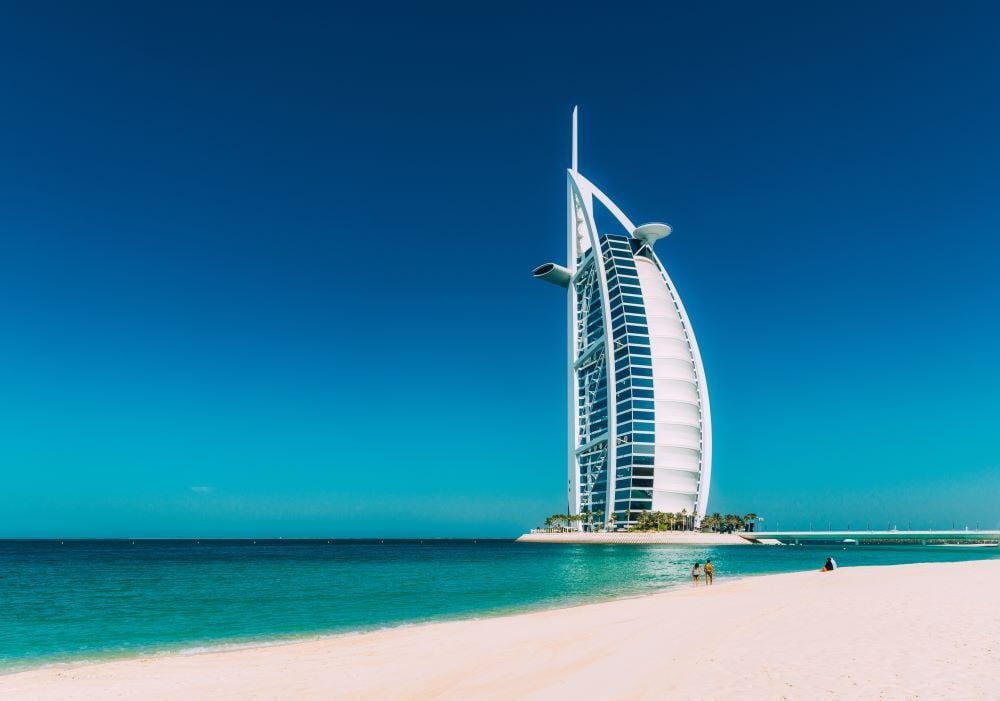
image source: katjen / Shutterstock.com
A Career Shaped by Clarity and Nerve
Wright’s career shows a clear understanding of what architecture has to do in real life. A building must serve the people who use it, answer the client’s brief and make sense in its setting. In some cases, it also has to carry a larger public meaning. That is where his work becomes most interesting.
This is particularly clear in the Burj Al Arab. The brief was not simply to design a luxury hotel, but to create a building that could stand for Dubai, much as the Eiffel Tower does for Paris or the Sydney Opera House for Sydney. Wright answered that rather formidable request with a simple idea, a contemporary sail rising from the Gulf.
What makes the decision endure is the clarity of the sail, its position off Jumeirah and the way it draws Dubai’s maritime past into a modern hotel form. Seen from land, sea or air, the building gives the city a figure on the water, instantly recognisable, but still rooted in place.
Today, Wright leads Wright Kuruvilla Architects with Geku Kuruvilla George, a partnership that goes back to the construction of the Burj Al Arab. Their later work shows the same interest in buildings with a strong identity, but with more attention to efficiency, environmental performance and commercial sense. It is a more measured chapter, and perhaps a more useful one.
Burj Al Arab - Dubai
The Burj Al Arab remains Wright’s defining project. Designed from 1993 and completed in 1999, the all-suite hotel was conceived as a landmark for Dubai at a formative moment in the city’s modern development. Set on its own island off Jumeirah, the building rises as a modern sail, its form both theatrical and remarkably simple.
The building’s power comes from that instant recognition. Plenty of buildings are tall, costly or technically demanding; only a small number settle into the public imagination. The Burj Al Arab did so because the idea is clear without being thin. Its sail form is easy to grasp, yet it also carries the weight of serious engineering, from the structure itself to the dramatic atrium and the way the hotel is positioned offshore.
There is a plainness to the idea that gives it force. Dubai wanted a building that could be seen from a distance, remembered by visitors and linked unmistakably to its setting. Wright’s answer was bold but not obscure. The hotel became more than a private hospitality project because people quickly began to read it as part of Dubai itself.
Its timing also matters. The Burj Al Arab arrived before many of the towers and districts now associated with the city, before the Burj Khalifa and before Downtown Dubai took its present form. It belongs to an earlier chapter of modern Dubai and helped fix one of the city’s first global images as coastal, ambitious and instantly recognisable.
Landmarks Around the World
CURV, Vancouver
CURV in Vancouver shows Wright working in a more measured, contemporary register. Described by WKA as a 60-storey high-end residential Passivhaus tower, the project treats architectural identity and energy performance as two priorities running in parallel, rather than as separate features. Its curved form gives the building presence, but the more interesting point is practical, as it proves that a tall residential tower can be both distinctive and more energy-efficient.
That balance feels particularly suited to Vancouver, a city closely associated with outdoor life, water and mountains. CURV reflects a different direction in Wright’s work. It combines a luxury residential brief with the demanding Passivhaus standard, showing that architectural character and environmental performance can be pursued together. It is a quieter project than the Burj Al Arab, but no less carefully considered.
South Quarter, Jakarta
South Quarter in Jakarta shows Wright working at a broader urban scale. The mixed-use development brings offices, retail, and dining spaces together across three towers, with a form that feels softer and less singular than the Burj Al Arab.
Here, the interest is not in one instantly recognisable outline, but in how the buildings work as a group. The façades and canopy are designed to help reduce energy demand, while water conservation is built into the project. It is a practical scheme as much as a visual one, and it shows Wright’s ability to handle a large commercial brief without losing architectural character.
Ribbon of Light, Tehran
Ribbon of Light in Tehran shows Wright’s interest in giving mixed-use buildings a clear public face. The ten-storey project brings retail, office space and wedding halls into one structure, with a silver ribbon used to mark the different functions of the building.
It is a straightforward idea, but an effective one. Mixed-use buildings can often feel divided or anonymous, particularly when several uses are brought together under one roof. Here, the ribbon gives the façade order and movement, while making the building easier to understand from the street.
Quantum of the Seas and the North Star
Wright’s work has also extended beyond buildings on land. For Royal Caribbean’s Quantum of the Seas, WKA helped develop the ship’s exterior design and SeaPlex, a multi-function interior space. Its most recognisable feature is the North Star, a glass viewing pod that lifts guests above the ship and out over the sea.
It is a different kind of project, but the interest is familiar. As with Wright’s buildings, the idea is easy to grasp and closely tied to experience. The North Star gives the ship a clear point of identity, while offering passengers a view that feels simple, direct and closely tied to the sea.
Celebrity EDGE continues Wright’s work at sea. WKA worked with Celebrity Cruises on the ship’s open decks and exterior, contributing to a vessel shaped around open-air movement and views across the water. Here, architecture is not fixed in one place. It is experienced across decks, around pools and along the edges of the ship, with the sea always close by.
The project shows how Wright’s thinking can go beyond conventional buildings. The main focus is still on form, recognition and the way people experience a place, but the setting is mobile and shaped by movement. At sea, the landmark becomes the vessel itself.
Collectively, these projects offer a good point from which to understand Wright’s wider career. Although the Burj Al Arab gave Dubai one of its most recognisable buildings, his profile extends far beyond this landmark project, to residential towers, mixed-use developments and ships at sea. Wright’s talent lies in making architecture clear but memorable. It sounds simple in theory, yet in practice, it is quite the trick.