November, 2026
Two Centuries of European and British Art Come to Sotheby's London This December
From the sunlit domes and carved facades of colonial-era India to the saturated nightlife of Belle Époque Pari...
Explore more
Latest stories
November, 2026
From the sunlit domes and carved facades of colonial-era India to the saturated nightlife of Belle Époque Pari...
Explore moreNovember, 2026
November, 2026
Each December, Abu Dhabi’s calendar fills with events that draw international attention to the capital. This y...
Explore morePublished: 9 September 2024
The biggest mall in the world depends on how you measure it. By total area, Iran Mall in Tehran is the largest mall in the world, at a reported 1.95 million square metres, although Guinness World Records still names The Dubai Mall, home to more than 1,200 stores, an aquarium and an Olympic-size ice rink, as the record holder at 1.12 million square metres. By leasable shop space, the New South China Mall in Dongguan leads, at around 660,000 square metres. Here are the eleven largest shopping malls, and what makes each one worth the visit.
Each entry below gives the city and country, the size in square metres and square feet, and the number of stores, measured by Gross Leasable Area (GLA) and Gross Floor Area (GFA) where figures are available.
Mall rankings differ because sources measure different things. Gross leasable area (GLA) is the floor space that can be rented to shops, restaurants and other tenants, so it shows how much retail a mall can hold. Total floor area, or gross floor area (GFA), counts everything under the roof, including corridors, car parks, aquariums, hotels and other non-retail space. A mall with major attractions can lead on total area yet sit well down a GLA list. Figures are also usually supplied by owners and change after expansions, so two reliable sources can disagree. That is why Iran Mall, The Dubai Mall and the New South China Mall can each be called the biggest.
The world's largest malls are more than just shopping destinations, they are economic generators that contribute greatly to the growth of the nations where they are located. These mega-structures boost economic activity by creating thousands of jobs, encouraging tourism, and assisting small and large businesses. They attract both locals and international tourists, resulting in a thriving business ecology. These malls also encourage urban development, typically resulting in the construction of hotels, residential areas, and entertainment centres around them.
For example, The Dubai Mall, which recorded 111 million visits in 2024, has become one of the world's most popular tourist destinations, contributing billions of dollars to the UAE economy. These malls not only act as shopping centres, but have improved the country's cultural and social fabric, offering venues for entertainment, culture, and business, thereby stimulating local as well as global commerce.
Location: Dongguan, China
Size: 660,000 m² (7.1 million sq ft) GLA; 892,000 m² (9.6 million sq ft) GFA
Stores: space for around 2,350
Opened: 2005
The New South China Mall is the world's largest mall by gross leasable area, with room for around 2,350 stores under one roof. It has held that title since opening in 2005, but occupancy has been very low for much of its history, earning it the nickname "the ghost mall of the world".
Location: Beijing, China
Size: 557,000 m² (6.0 million sq ft) GLA; 680,000 m² (7.3 million sq ft) GFA
Stores: more than 1,000
Opened: 2004
Located on Beijing's Fourth Ring Road, the Golden Resources Mall offers six levels of premium apparel, jewellery, electronics and home decor. It cost an estimated RMB 3.8 billion to build. It was the world's largest mall by leasable area until 2005, when the New South China Mall opened.
Location: Bangkok, Thailand
Size: 525,000 m² (5.65 million sq ft) retail area; 750,000 m² (8.1 million sq ft) GFA
Stores: more than 500
Opened: 2018
Although CentralWorld has a larger total area, ICONSIAM has more leasable space, making it the largest mall in Thailand on that measure. Set on the banks of the Chao Phraya River, this mixed-use complex pairs retail with an indoor floating market, a river museum and ICONLUXE, a luxury wing of around 25,000 m² (270,000 sq ft).
Location: Mandaluyong, Philippines
Size: about 474,000 m² (5.1 million sq ft) of floor space
Stores: more than 900
Opened: 1991
The shops are spread across two buildings, fittingly named Mega A and Mega B. More than 200 restaurants and food stalls serve local and international cuisine, while 14 cinema screens, including an IMAX theatre, a bowling alley, a skating rink and an arcade provide more entertainment in a single visit.
Location: Pasay, Philippines
Size: about 590,000 m² (6.35 million sq ft) total floor area
Stores: more than 660, including over 200 dining outlets
Opened: 2006
The competition for the largest mall in the Philippines is fierce. With IKEA's recent addition, SM Mall of Asia now ranks first in terms of floor area, but not leasable area. Its waterfront promenade offers views of Manila Bay, and on-site attractions include an ice skating rink, an indoor amusement park and an aquarium.
Location: Bangkok, Thailand
Size: 830,000 m² (8.9 million sq ft) total area; about 410,000 m² (4.4 million sq ft) GLA
Stores: more than 500
Opened: 1990
CentralWorld goes well beyond retail, with a cooking school, karaoke venues and more than 100 restaurants and cafés. It is also a cultural destination, featuring fashion events, concerts and festivals alongside its regular retail offer. A hotel and office tower sit on the same site.
Location: Dubai, UAE
Size: 1,124,000 m² (12.1 million sq ft) total area; about 350,000 m² (3.8 million sq ft) GLA
Stores: more than 1,200
Opened: 2008
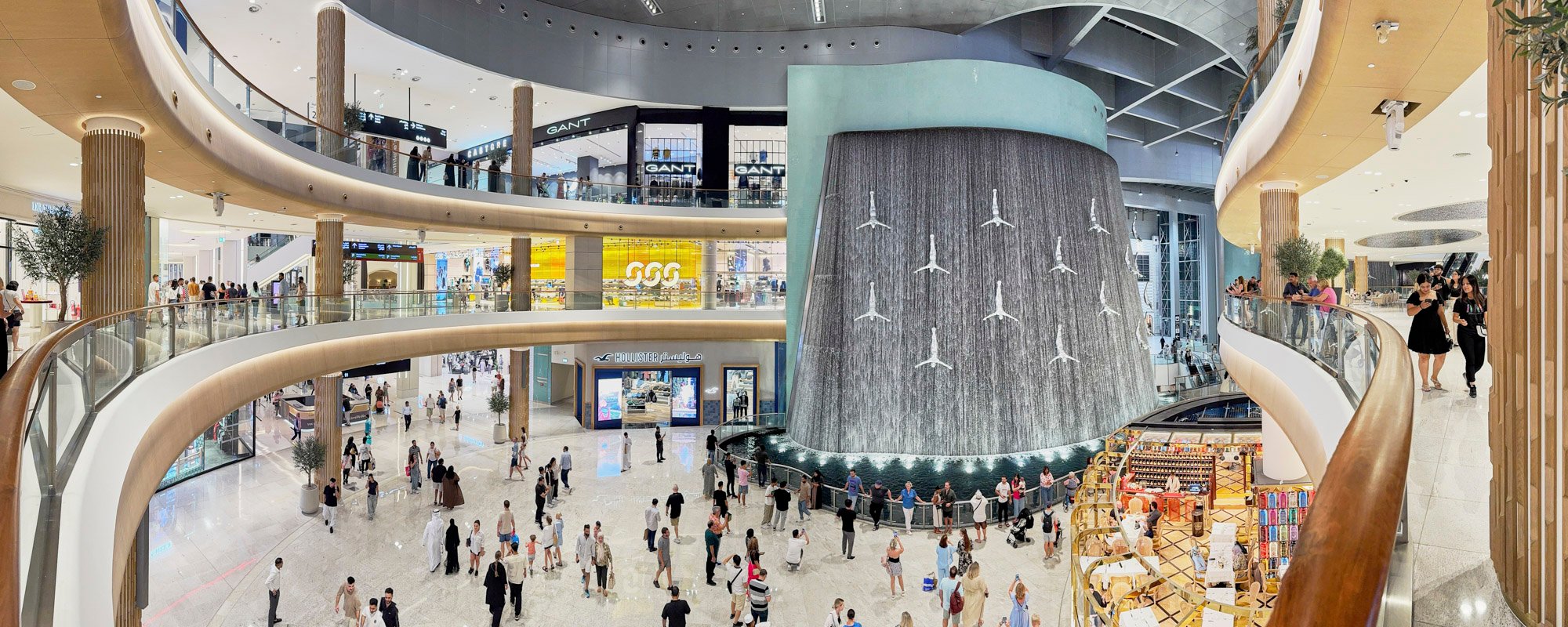
The Dubai Mall is the largest shopping mall in the world by total area according to Guinness World Records, and the most visited place on earth, with 111 million visitors in 2024. It has more than 1,200 stores, supported by over 160 dining outlets. By leasable area it sits well below the New South China Mall, so the title depends on the measure used.
Opened in 2008, it is the public entrance to the Burj Khalifa, which is reached from the lower ground level inside the mall. The Dubai Aquarium and Underwater Zoo has held the Guinness record for the world's largest acrylic panel, there is an Olympic-size ice rink, and the Dubai Fountain performs outside on Burj Khalifa Lake. Fashion Avenue, a dedicated luxury wing, adds to the draw.
In 2024, Emaar announced an AED 1.5 billion expansion adding 240 new luxury retail and dining outlets. The plan has since risen to 279 outlets, and the first precinct, The District, has opened near the ice rink. Emaar's investor updates also outline a further extension towards Grand Drive, adding 440,000 square feet of leasable area, with completion targeted for the second half of 2028.
For residences within walking distance of the mall, explore Downtown Dubai, including apartments in the Burj Khalifa area

Location: Edmonton, Canada
Size: about 350,000 m² (3.8 million sq ft) GLA; about 490,000 m² (5.3 million sq ft) total area
Stores: more than 800
Opened: 1981
Built in 1981, West Edmonton Mall includes a large indoor amusement park and waterpark, a mini-golf course and a bowling alley. Mall of America is larger by total area, but West Edmonton Mall has more leasable space, which makes it the largest mall in North America on that measure.
Location: Istanbul, Turkey
Size: about 420,000 m² (4.5 million sq ft) total area
Stores: 343
Opened: 2005
İstanbul Cevahir, in the Şişli district on the European side of the city, is often named Europe's largest mall by total area. It brings shopping, dining, events and attractions together across six floors, with a cinema and an indoor roller coaster. Its leasable area is much smaller than its footprint, at around 110,000 m² (1.2 million sq ft).
Location: Kuala Lumpur, Malaysia
Size: 700,000 m² (7.5 million sq ft) total built-up area; about 325,000 m² (3.5 million sq ft) of mall space
Stores: more than 1,000 retail shops
Opened: 2003
Housed in two 48-storey towers, Berjaya Times Square does not have the typical appearance of a mega-mall, but inside the scale is clear. It combines more than 1,000 retail shops and 65 food outlets with Malaysia's first IMAX theatre, an indoor theme park and 1,200 luxury service suites.
Location: Tehran, Iran
Size: 1,950,000 m² (21 million sq ft) reported total area; 267,000 m² (2.9 million sq ft) GLA in the first phase
Stores: 708 retail units in the first phase
Opened: 2018
Iran has a long bazaar tradition, and the Iran Mall brings it up to date. The first phase opened in 2018, and at a reported 1.95 million m² the mall is widely described as the largest in the world by total area, although Guinness World Records still lists The Dubai Mall as the record holder. As a multi-use venue with gardens, cultural spaces and a large library, its leasable area is far smaller than its overall footprint.
The world's largest malls reflect their destinations' economic and cultural objectives. These malls create jobs, promote tourism, and function as cultural centres, attracting visitors from all over the world. Each of these malls provides a glimpse into the future of retail and commerce. As cities expand and consumer expectations shift, these mega-structures will continue to transform urban landscapes, creating experiences that go beyond shopping.
Mall of America in Bloomington, Minnesota, is the largest mall in the United States, but it is not the biggest in the world. It covers about 5.6 million square feet (520,000 m²) in total, with roughly 2.8 million square feet (260,000 m²) of retail space and more than 500 stores. Several malls in this guide are far larger, including The Dubai Mall by total area and the New South China Mall by leasable area.